Patrick White: 'Look into a passing bus, and more often than not you will see something you would rather not'.
I read this sentence on the bus this morning. I can't recall what happened immediately afterwards, probably nothing poetic or noteworthy, but it would have been cute, kind of symmetrical or something, if at the full stop I had lifted my eyes from the page to see an open-mouthed woman glaring at me from the passing pavement. It would have been even cuter if, shamed by our contact, she had then stooped sharply to gather her chaotic and billowy shopping bags and shuffled off into a throng of school kids.
Friday, August 18, 2006

A poem by Robert Adamson (1997)
The language of oysters
Charles Olson sat back in his oyster-shed
working with words - 'mostly in a great
sweat of being, seeking to bind in speed' -
looked at his sheaf of pages, each word
an oyster, culled from the fattening grounds
of talk. They were nurtured from day one,
from the spat-fields to their shucking,
words, oysters plump with life. On Mooney Creek
the men stalk the tides for corruption.
They spend nights in tin shacks
that open at dawn onto our great brown river.
On the right tide they ride out
into the light in their punts, battered slabs
of aluminium with hundred-horse Yamahas on the stern
hammering tightly away, padded high-tech -
sucking mud into the cooling systems,
the motors leave a jet of hot piss in their wakes.
These power-heads indicate
the quality of the morning's hum.
The new boys don't wake from dreams
where clinkers crack, where mud sucks them under,
their grandfather's hands fumbling
accurately, loosening the knots. Back
at the bunker the hessian sacks are packed ready
and the shells grow into sliding white foothills.
A freezing mist clenches your fingers,
the brown steam now cold as fire:
plunge in and wash away last night's grog,
in the middle morning, stinging and wanting
the week to fold away until payday.
On the bank, spur-winged plovers stroll in pairs,
their beak-wattle chipped by frost,
each day blinking at the crack of sun.
Stalking for corruption? Signs.
Blue algae drifts through your brother's dream
of Gold Coasts, golf courses. The first settlement.
Charles Olson sat back in his oyster-shed
working with words - 'mostly in a great
sweat of being, seeking to bind in speed' -
looked at his sheaf of pages, each word
an oyster, culled from the fattening grounds
of talk. They were nurtured from day one,
from the spat-fields to their shucking,
words, oysters plump with life. On Mooney Creek
the men stalk the tides for corruption.
They spend nights in tin shacks
that open at dawn onto our great brown river.
On the right tide they ride out
into the light in their punts, battered slabs
of aluminium with hundred-horse Yamahas on the stern
hammering tightly away, padded high-tech -
sucking mud into the cooling systems,
the motors leave a jet of hot piss in their wakes.
These power-heads indicate
the quality of the morning's hum.
The new boys don't wake from dreams
where clinkers crack, where mud sucks them under,
their grandfather's hands fumbling
accurately, loosening the knots. Back
at the bunker the hessian sacks are packed ready
and the shells grow into sliding white foothills.
A freezing mist clenches your fingers,
the brown steam now cold as fire:
plunge in and wash away last night's grog,
in the middle morning, stinging and wanting
the week to fold away until payday.
On the bank, spur-winged plovers stroll in pairs,
their beak-wattle chipped by frost,
each day blinking at the crack of sun.
Stalking for corruption? Signs.
Blue algae drifts through your brother's dream
of Gold Coasts, golf courses. The first settlement.
Wednesday, August 16, 2006

Monday, August 14, 2006


Friday, August 11, 2006
Pick the difference
From The Fontana Dictionary of Modern Thought.
life style.
(1) In psychoanalytic theory (see PSYCHOANALYSIS), an ADLERIAN term for a child's method, modified continuously throughout its life, of coping with feelings of inadequacy and of attaining superiority and STATUS.
(2) In popular usage, all the observable characteristics of a person, e.g. his manner of dress, way of speaking, personal appearance, domestic habits, and choice of friends, which serve to indicate his value system and attitudes towards himself and aspects of his ENVIRONMENT. These characteristics serve as a social signal to others, who react accordingly with feelings of trust, admiration, liking, etc., or the opposite.
life style.
(1) In psychoanalytic theory (see PSYCHOANALYSIS), an ADLERIAN term for a child's method, modified continuously throughout its life, of coping with feelings of inadequacy and of attaining superiority and STATUS.
(2) In popular usage, all the observable characteristics of a person, e.g. his manner of dress, way of speaking, personal appearance, domestic habits, and choice of friends, which serve to indicate his value system and attitudes towards himself and aspects of his ENVIRONMENT. These characteristics serve as a social signal to others, who react accordingly with feelings of trust, admiration, liking, etc., or the opposite.

Thursday, August 10, 2006

When the rectangles fail
In this light vivid sharpens into grey and
Blue, one imposed on the other as if
Pasted
Massing upwards and zig-zagging on bitumen
Over stone, the sky, these stark stacked frontages seem to
Jiggle and thrum
I'm conscious of the tapping of
My hands
"This is the city", I think, "and
I feel like dying"
I feel like dying and yet I must have
Reached the Right Place for at my feet a
A man kicks out like a stricken fish
He is keening and still the thrum
"Perhaps the far off is not too far
Now", I say to him. "When the rectangles fail, or fade,
You will find disorder like everyone
Else"
Blue, one imposed on the other as if
Pasted
Massing upwards and zig-zagging on bitumen
Over stone, the sky, these stark stacked frontages seem to
Jiggle and thrum
I'm conscious of the tapping of
My hands
"This is the city", I think, "and
I feel like dying"
I feel like dying and yet I must have
Reached the Right Place for at my feet a
A man kicks out like a stricken fish
He is keening and still the thrum
"Perhaps the far off is not too far
Now", I say to him. "When the rectangles fail, or fade,
You will find disorder like everyone
Else"
Doubtful rissoles (taken from Alan Marshall's In Mine Own Heart)
Florrie's love for him was deep and unselfish, though it demanded from her occasional displays of calculated thoughfulness.
"Don't have rissoles today", she would say theatrically, talking from the side of her mouth as she bent over the table arranging the cutlery.
This unnecessary advice, unnecessary since no person in his right mind would eat rissoles in a cafe, always imbued rissoles with a more sinister quality than the most doubtful of them deserved. But Arthur regarded this warning as evidence of great thoughtfulness.
"Don't have rissoles today", she would say theatrically, talking from the side of her mouth as she bent over the table arranging the cutlery.
This unnecessary advice, unnecessary since no person in his right mind would eat rissoles in a cafe, always imbued rissoles with a more sinister quality than the most doubtful of them deserved. But Arthur regarded this warning as evidence of great thoughtfulness.
Sunday, August 06, 2006

Saturday, August 05, 2006


Canker Candy
Hard Candy
Director: David Slade.
Screenplay: Brian Nelson.
Margaret Pomeranz (3.5): '... you come out and you think, "Where do I stand morally with regard to this film?"'.
David Stratton (3.5): 'You come out asking a lot of questions ...'.
Paul Byrnes (4): '... this swamp gets very murky indeed. Bring your moral compass'.
Philippa Hawker (2.5): 'There is something a little limited ... about the direction Brian Nelson's script takes, no matter how many plot twists, quasi-revelations and nasty physical confrontations are thrown into the mix'.
Luke Buckmaster (2.5): 'David Slade has managed to horrify his audiences without flashing them a series of grisly pictures, and has taken that logic to a place which can only barely justify its means'.
Call me old fashioned but using an issue as complex and sensitive as paedophilia as the basis for a horror-thriller film -- whose main function is entertainment -- is offensive. At the end of it, I certainly was asking a lot of questions, still am, but I doubt they're the same ones that DS refers to.
Somehow I can imagine the rock-video-trained former ad man Slade wetting his lips as he pored over the early drafts of Nelson's script. I can imagine him thinking 'Let's make this taboo mainstream! That's what it is isn't it? Anyway, audiences'll LOVE IT! And for the doubters, the ones who think we're off compass, we'll weave in a moral subtext -- subtle stuff, sophisticated stuff. No kid or parent or (god forbid) victim need see every ambition of this film. God forbid, that's obvious (ha ha ha). And hey, the Japanese'll LOVE IT! It's gotta be one of the last taboos over here. That's what it is isn't it? And hey, the Russians'll LOVE IT!'
Director: David Slade.
Screenplay: Brian Nelson.
Margaret Pomeranz (3.5): '... you come out and you think, "Where do I stand morally with regard to this film?"'.
David Stratton (3.5): 'You come out asking a lot of questions ...'.
Paul Byrnes (4): '... this swamp gets very murky indeed. Bring your moral compass'.
Philippa Hawker (2.5): 'There is something a little limited ... about the direction Brian Nelson's script takes, no matter how many plot twists, quasi-revelations and nasty physical confrontations are thrown into the mix'.
Luke Buckmaster (2.5): 'David Slade has managed to horrify his audiences without flashing them a series of grisly pictures, and has taken that logic to a place which can only barely justify its means'.
Call me old fashioned but using an issue as complex and sensitive as paedophilia as the basis for a horror-thriller film -- whose main function is entertainment -- is offensive. At the end of it, I certainly was asking a lot of questions, still am, but I doubt they're the same ones that DS refers to.
Somehow I can imagine the rock-video-trained former ad man Slade wetting his lips as he pored over the early drafts of Nelson's script. I can imagine him thinking 'Let's make this taboo mainstream! That's what it is isn't it? Anyway, audiences'll LOVE IT! And for the doubters, the ones who think we're off compass, we'll weave in a moral subtext -- subtle stuff, sophisticated stuff. No kid or parent or (god forbid) victim need see every ambition of this film. God forbid, that's obvious (ha ha ha). And hey, the Japanese'll LOVE IT! It's gotta be one of the last taboos over here. That's what it is isn't it? And hey, the Russians'll LOVE IT!'
Friday, August 04, 2006


Directing traffic with his tongue
I haven't read much Shakespeare nor seen many of the Puffy Panted One's plays but I thought this description of him (and his 'tongue'), included in a three page 'Note on Shakespeare' by a 20 year old Harold Pinter, was funny.
He belongs, of course, ultimately, to a secret society, a conspiracy, of which there is only one member: himself. In that sense, and in a number of others too, he is a malefactor; a lunatic; a deserter; a conscientious objector; a guttersnipe; a social menace and an Anti-Christ.
He is also a beggar; a road sweeper; a tinker; a hashish-drinker; a leper; a chicken-fancier; a paper-seller; a male nurse; a sun-worshipper and a gibbering idiot.
He is no less a traffic policeman; a rowing blue; a rear-gunner; a chartered accountant; a best man; a bus-conductor; a paid guide; a marriage-guidance counsellor; a church-goer; a stage carpenter; an umpire; an acrobat and a clerk of the court.
His tongue is guttural, Arabic, pepperish, composed, parsimonious, voluminous, rabid, diarrhoeic, transparent, laundered, dainty, mellifluous, consonantal, stammering, scabrous, naked, blade-edged, one-legged, piercing, hushed, clinical, dumb, convulsed, lewd, vicious, voracious, inane, Tibetan, monosyllabic, epileptic, raucous, ministerial, sudden, Sudanese, palpitating, thunderous, earthy, whimsical, acrimonious, wintry, malicious, fearsome, blighted, blistered, mouldy, tantalizing, juicy, innocent, lordly, gluttonous, irreverent, blasphemous, avaricious, autumnal, blasted, ecstatic, necromantic, gentle, venomous, somnambulistic, monotonous, uproarious, feverish, austere, demented, deathly, fractious, obsessed, ironic, palsied, morbid, sanctimonious, sacrilegious, calm, cunning, cannibalistic and authoritative.
Character of character
Harold Pinter speaking at the National Student Drama Festival in Bristol in 1962.
Given characters who possess a momentum of their own, my job is not to impose upon them, not to subject them to a false articulation, by which I mean forcing a character to speak where he could not speak, making him speak in a way he could not speak, or making him speak of what he could never speak. The relationship between author and characters should be a highly respectful one, both ways. And if it's possible to talk of gaining a kind of freedom from writing, it doesn't come from leading one's characters into fixed and calculated postures, but by allowing them to carry their own can, by giving them legitimate elbowroom. This can be extremely painful. It's much easier, much less pain, not to let them live.
Wednesday, August 02, 2006
An 'old chestnut' (or just something time-fritterers talk about)?
Angela Bennie's essay in the SMH (Spectrum, Jul 29-30) challenges the idea that 'it is a critic's right to be subjective'. She asks:
And answers:
I'm tempted to brush this 'old chestnut' aside as forever philosophically impenetrable, but then I'm a fairly simple man when it comes to these issues and I know that on many occasions I've come to value a work of art more after learning something of its history, religious significance or technical detail, for example, all delivered (and I'm feeling a tad self-conscious here) ... objectively. (And very often by a critic -- in the broad sense of the term.)
Yet it turns out I might not be receiving the best customer service in this regard. Bennie highlights the ominous possibility that far from 'analysing the evidence in the work' or steering intelligently around such things as 'the sway of opinion over judgement', the use of 'banal' critical language' or 'the promotion of the ideological status quo' (a collection of perceptions of Australian critics from abroad (!)), 'the [Australian] critic's fundamental critical task is to give opinion, the stronger the better, especially opinion clotted with bile'.
They'll be copping an email from me in the morning, that's for sure!
She also provides a couple of lovely lines from Rebecca West's 1914 essay The Duty of Harsh Criticism. Forgive the third-handedness of this, but I'm going to transcribe these lines as they appear in Bennie's piece before tracking down the primary source myself - assuming I don't get distracted or become disinterested. West warned:
There's a book or two in that paragraph but it certainly won't be mine. I'd get too hung up on the definitions for a start. And while I like the idea that through art 'we cultivate annoyance with inessentials', I'm not sure I agree with the 'only'.
... what happens to a work of art in a culture that sees criticism as nothing more than a democracy of free-falling, free-floating subjectivities?
And answers:
Within such a culture the work of art loses any possibility of, or claim to, aesthetic distinction, or difference. It would be just one more commodity in a culture that reduces everything towards the mean, that thrives on the exaltation of the average, to use Patrick White's unforgettable, spine-tingling description of Australian culture.
I'm tempted to brush this 'old chestnut' aside as forever philosophically impenetrable, but then I'm a fairly simple man when it comes to these issues and I know that on many occasions I've come to value a work of art more after learning something of its history, religious significance or technical detail, for example, all delivered (and I'm feeling a tad self-conscious here) ... objectively. (And very often by a critic -- in the broad sense of the term.)
Yet it turns out I might not be receiving the best customer service in this regard. Bennie highlights the ominous possibility that far from 'analysing the evidence in the work' or steering intelligently around such things as 'the sway of opinion over judgement', the use of 'banal' critical language' or 'the promotion of the ideological status quo' (a collection of perceptions of Australian critics from abroad (!)), 'the [Australian] critic's fundamental critical task is to give opinion, the stronger the better, especially opinion clotted with bile'.
They'll be copping an email from me in the morning, that's for sure!
She also provides a couple of lovely lines from Rebecca West's 1914 essay The Duty of Harsh Criticism. Forgive the third-handedness of this, but I'm going to transcribe these lines as they appear in Bennie's piece before tracking down the primary source myself - assuming I don't get distracted or become disinterested. West warned:
Decidedly, we shall not be safe if we forget the things of the mind. Indeed, if we want to save our souls, the mind must lead a more athletic life than it has ever done before and must more passionately than ever practise and rejoice in art. For only through art do we cultivate annoyance with inessentials, powerful and exasperated reactions against ugliness, a ravenous appetite for beauty. These are true guardians of the soul.
There's a book or two in that paragraph but it certainly won't be mine. I'd get too hung up on the definitions for a start. And while I like the idea that through art 'we cultivate annoyance with inessentials', I'm not sure I agree with the 'only'.
Tuesday, August 01, 2006


Is this a conversation you have heard?
A: They turned him over?
B: Yes, more than once.
A: More than once?
B: Yes.
A: More than twice?
B: No.
A: So twice.
B: (pause) Yes.
A: And what did they see?
B: What could they have seen?
A: Marks, scars, a wound?
B: No wounds.
A: Marks then, or scars?
B: A bruise above his hip.
A: god!
B: But it was not caused by the accident.
A: Not?
B: No.
A: Anything else?
B: No.
A: So nothing?
B: No.
A: Nothing?
B: Other than him being there.
A: But then how do they know it wasn't him?
B: They don't ...
A: ... But ...
B: ... They were speculating. Nothing is certain.
A: god ...
B: Yes, more than once.
A: More than once?
B: Yes.
A: More than twice?
B: No.
A: So twice.
B: (pause) Yes.
A: And what did they see?
B: What could they have seen?
A: Marks, scars, a wound?
B: No wounds.
A: Marks then, or scars?
B: A bruise above his hip.
A: god!
B: But it was not caused by the accident.
A: Not?
B: No.
A: Anything else?
B: No.
A: So nothing?
B: No.
A: Nothing?
B: Other than him being there.
A: But then how do they know it wasn't him?
B: They don't ...
A: ... But ...
B: ... They were speculating. Nothing is certain.
A: god ...
Monday, July 31, 2006

Sunday, July 30, 2006
Two Johnny Cash songs that'll put a twist in your belly (well they did mine the first time I heard them)
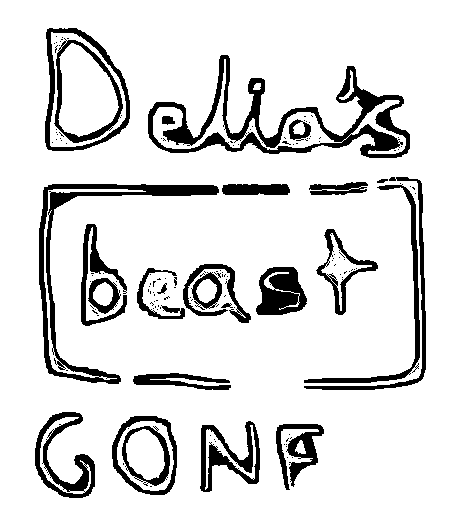
Is this art that challenges you not to like it? Or am I missing something? Something (looking both ways) ... biblical? Maybe the prisoner in DELIA'S GONE has not killed anyone at all -- he's just fantasising about exorcising the 'devilish woman' that dwells in him. But then the Memphis brothel (?) action seems too real, as if it's suggesting a moral motive for the killing. I don't know.
It's hard not to connect these two songs, actually. But I won't comment on this further as I don't want to trample on any ambiguity they may possess (plus I don't really have much to say at the moment).
DELIA'S GONE
Delia, oh Delia, Delia all my life
If I hadn't-a shot poor Delia, I'd have had her for my wife
Delia's gone, one more round, Delia's gone
I went up to Memphis, and I met Delia there
Found her in her parlor, and I tied her to her chair
Delia's gone, one more round, Delia's gone
She was low-down and triffilin', and she was cold and mean
Kind of evil make me want to grab my sub-machine
Delia's gone, one more round, Delia's gone
First time I shot her, I shot her in the side
Hard to watch her suffer, but with the second shot she died
Delia's gone, one more round, Delia's gone
But jailer, oh jailer, jailer I can't sleep
'Cuz all around my bedside I hear the patter of Delia's feet
Delia's gone, one more round, Delia's gone
So if your woman's devilish, you can let her run
Or you can bring her down and do her like Delia got done
Delia's gone, one more round, Delia's gone
Delia's gone, one more round, Delia's gone

THE BEAST IN ME
The beast in me
Is caged by frail and fragile bars
Restless by day
And by night rants and rages at the stars
God help the beast in me
The beast in me
Has had to learn to live with pain
And how to shelter from the rain
And in the twinkling of an eye
Might have to be restrained
God help the beast in me
Sometimes it tries to kid me
That it's just a teddy bear
And even somehow manage to vanish in the air
And that is when I must beware
Of the beast in me that everybody knows
They've seen him out dressed in my clothes
Patently unclear if it's New York or New Year
God help the beast in me
The beast in me
It's hard not to connect these two songs, actually. But I won't comment on this further as I don't want to trample on any ambiguity they may possess (plus I don't really have much to say at the moment).
DELIA'S GONE
Delia, oh Delia, Delia all my life
If I hadn't-a shot poor Delia, I'd have had her for my wife
Delia's gone, one more round, Delia's gone
I went up to Memphis, and I met Delia there
Found her in her parlor, and I tied her to her chair
Delia's gone, one more round, Delia's gone
She was low-down and triffilin', and she was cold and mean
Kind of evil make me want to grab my sub-machine
Delia's gone, one more round, Delia's gone
First time I shot her, I shot her in the side
Hard to watch her suffer, but with the second shot she died
Delia's gone, one more round, Delia's gone
But jailer, oh jailer, jailer I can't sleep
'Cuz all around my bedside I hear the patter of Delia's feet
Delia's gone, one more round, Delia's gone
So if your woman's devilish, you can let her run
Or you can bring her down and do her like Delia got done
Delia's gone, one more round, Delia's gone
Delia's gone, one more round, Delia's gone
THE BEAST IN ME
The beast in me
Is caged by frail and fragile bars
Restless by day
And by night rants and rages at the stars
God help the beast in me
The beast in me
Has had to learn to live with pain
And how to shelter from the rain
And in the twinkling of an eye
Might have to be restrained
God help the beast in me
Sometimes it tries to kid me
That it's just a teddy bear
And even somehow manage to vanish in the air
And that is when I must beware
Of the beast in me that everybody knows
They've seen him out dressed in my clothes
Patently unclear if it's New York or New Year
God help the beast in me
The beast in me
Saturday, July 29, 2006
A poem by Philip Larkin (1951?)
'To put one brick upon another'
To put one brick upon another,
Add a third, and then a fourth,
Leaves no time to wonder whether
What you do has any worth.
But to sit with bricks around you
While the winds of heaven bawl
Weighing what you should or can do
Leaves no doubt of it at all.
To put one brick upon another,
Add a third, and then a fourth,
Leaves no time to wonder whether
What you do has any worth.
But to sit with bricks around you
While the winds of heaven bawl
Weighing what you should or can do
Leaves no doubt of it at all.

Thursday, July 27, 2006



Tuesday, July 25, 2006
A bit of nonsense on Mars's Day
Characters
Princess Anne's bull terrier Dotty
Queen Elizabeth II's corgi Pharos
Scene
Sandringham estate, rear lawn
----------------------------------------------------------------------------------
Dotty: It's a bit grey today, isn't it?
Pharos: Yes.
Dotty: A bit dull.
Pharos: Oh, I wouldn't say dull.
Dotty: No?
Pharos: No.
Dotty: What would you say then?
Pharos: Well, it's clearly grey - as noted - but it's also bracing I would say. Mostly bracing.
Dotty: You would say?
Pharos: Yes, that is the dominant atmospheric phenomenon that is making itself apparent to me at this moment.
Dotty: Apparent?
Pharos: Indeed.
Dotty: dominant?
Pharos: Apparently.
Dotty (pause): I wouldn't say bracing.
Pharos: No?
Dotty: No.
Pharos: No, you wouldn't.
Dotty: What?
Pharos: You haven't.
Dotty: Yes. (pause) Oh, I'm so bored! It's so dull today. Pharos, let's play a game.
Pharos: All right. Will it be like the last one?
Dotty: Oh no, nothing like the last one. This one'll be much more fun.
Pharos: All right. How do we play?
Dotty: Simple. You run away like a cut* rabbit while I chase you screaming "when I catch you I'm going to rip your legs off and watch you bleed to death".
Pharos (chuckling): But of course you want actually do that.
Dotty (pause, then chuckling): Of course. So you want to get started? How about I count to five?
* I originally had 'shot rabbit' but then that didn't seem right cos a shot rabbit would probably not be running anywhere, or very far, or for very long, which would make the game not very fun. Oh god, my little dog play is going all schlock! The next change will see Dotty pouncing on Pharos with a five foot hedge trimmer in one paw and a rusty spanner in the other (both items stolen from Prince Philip's shed; Dotty's other paws being used for posture and stability).
Princess Anne's bull terrier Dotty
Queen Elizabeth II's corgi Pharos
Scene
Sandringham estate, rear lawn
----------------------------------------------------------------------------------
Dotty: It's a bit grey today, isn't it?
Pharos: Yes.
Dotty: A bit dull.
Pharos: Oh, I wouldn't say dull.
Dotty: No?
Pharos: No.
Dotty: What would you say then?
Pharos: Well, it's clearly grey - as noted - but it's also bracing I would say. Mostly bracing.
Dotty: You would say?
Pharos: Yes, that is the dominant atmospheric phenomenon that is making itself apparent to me at this moment.
Dotty: Apparent?
Pharos: Indeed.
Dotty: dominant?
Pharos: Apparently.
Dotty (pause): I wouldn't say bracing.
Pharos: No?
Dotty: No.
Pharos: No, you wouldn't.
Dotty: What?
Pharos: You haven't.
Dotty: Yes. (pause) Oh, I'm so bored! It's so dull today. Pharos, let's play a game.
Pharos: All right. Will it be like the last one?
Dotty: Oh no, nothing like the last one. This one'll be much more fun.
Pharos: All right. How do we play?
Dotty: Simple. You run away like a cut* rabbit while I chase you screaming "when I catch you I'm going to rip your legs off and watch you bleed to death".
Pharos (chuckling): But of course you want actually do that.
Dotty (pause, then chuckling): Of course. So you want to get started? How about I count to five?
* I originally had 'shot rabbit' but then that didn't seem right cos a shot rabbit would probably not be running anywhere, or very far, or for very long, which would make the game not very fun. Oh god, my little dog play is going all schlock! The next change will see Dotty pouncing on Pharos with a five foot hedge trimmer in one paw and a rusty spanner in the other (both items stolen from Prince Philip's shed; Dotty's other paws being used for posture and stability).
Monday, July 24, 2006
Moustachioed monkey dreaming about an emaciated monkey with suction caps
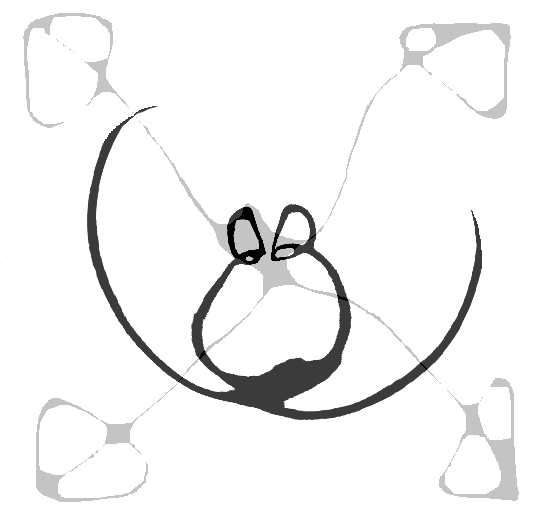
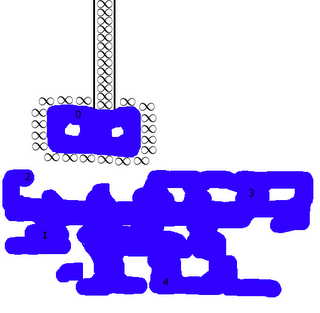
I'm beginning to worry that every picture I draw from now on will appear to me as somehow resembling a monkey or monkeys. (For example: What's that lunarbrogue? (it'll be a house, say). That's a monkey made out of bricks. And the chimney? Its neck. So the monkey doesn't have a head? It's an abstract drawing for god's sake.)
Two melancholics (in the days before MA)
A snippet of John Keats's Ode to a Nightingale (vandalised by a juvenile faux-nihilist who thinks he's funny but who is actually not funny because he's shitting on a meisterwerk) and, below it, a complete poem by Edward Thomas. Both are taken from The New Oxford Book of English Verse. (Click to enlarge.)

* What, Tasmania?
** A sacred fountain on Mt Helicon that came into being care of a clumsy winged horse. Visited occasionally by a gaggle of water nymphs called the Muses. Pretty sure there was no shiatsu in those days, though must check this.
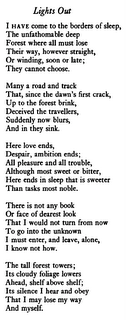
Somehow this is beyond flippancy.

* What, Tasmania?
** A sacred fountain on Mt Helicon that came into being care of a clumsy winged horse. Visited occasionally by a gaggle of water nymphs called the Muses. Pretty sure there was no shiatsu in those days, though must check this.
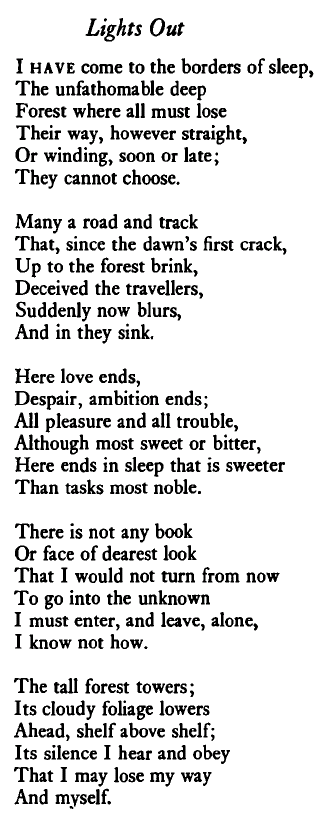
Somehow this is beyond flippancy.
Sunday, July 23, 2006

The albino was supposed to be deep
Lawrence Ferlinghetti on the midnight cowboys who scrawl on coasters and serviettes:
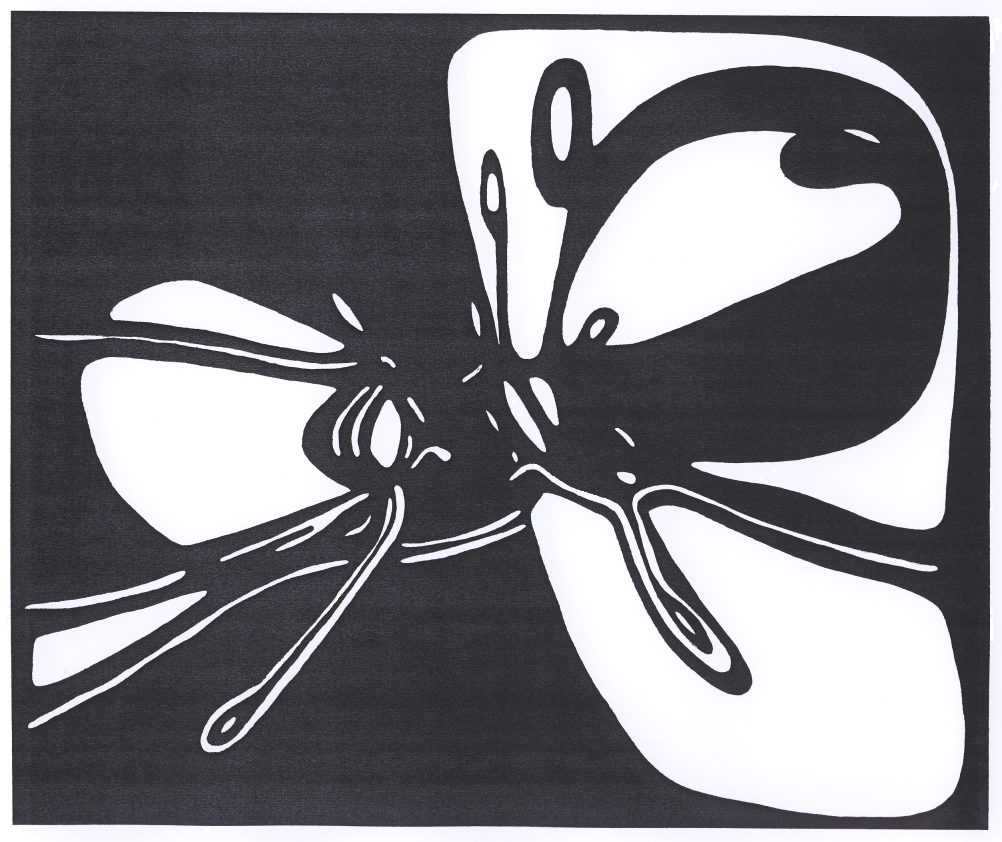
Oh god, don't anyone think that my effort a few days ago lurks in this acreage! The albino was supposed to be deep. (In a surreal sort of way, I'll admit. In fact, so unfathomably embedded in my subconscious was the pale-skinned observer that even I at the time of writing couldn't completely understand it. Still can't, actually! As I said: DEEP.) Anyway, maybe this picture'll distract the lawyers ...

My poetics are totally different to something like the Ginsberg school, which is based on the idea of 'first thought, best thought' ... It is a solid concept to get the most direct transcription of your consciousness, especially if the person doing it has an original mind. Allen Ginsberg had a fascinating and genius mind and so the poetry is fascinating and genius. But when this method is laid on to thousands of students, many of whom don't have original minds, you get acres of boring poetry.
Oh god, don't anyone think that my effort a few days ago lurks in this acreage! The albino was supposed to be deep. (In a surreal sort of way, I'll admit. In fact, so unfathomably embedded in my subconscious was the pale-skinned observer that even I at the time of writing couldn't completely understand it. Still can't, actually! As I said: DEEP.) Anyway, maybe this picture'll distract the lawyers ...

Saturday, July 22, 2006

Progressives, stand!
Having just re-read Clive Hamilton's Quarterly Essay What's Left? The Death of Social Democracy, I'm eager to make a comment or two. So here goes ...
First, the dramatic news: "The Australian Labor Party has served its historical purpose and will wither and die as the progressive force of Australian politics". Hamilton heaps a large portion of the blame for this on Labor's factional system. For while the factions "once served as a means of organising to promote ideas that were held passionately by their members ... [they] now divide only notionally along ideological lines. They have become vehicles for ambition and mutual support".
Hamilton makes this prediction on his way to proposing a new direction for progressive politics in Australia. Exit the ALP's traditional "deprivation model", characterised by values such as protection (of the working class) from exploitation and improved living conditions for the poor. Enter the counter-consumption model, where the destructive forces of consumer capitalism, fuelled by peoples' ever-increasing "material acquisitiveness", are kept under control by a more compassionate and forward-thinking government, lighting the way for a community-minded, family-friendly and cheerful populace.*
This sort of transformation would be a big ask for a party as bureaucratic and process driven (should I say Byzantine?) as the ALP. To begin with such a thorough re-evaluation of the party's foundations would have to be based on strong arguments, sound evidence and whatever the factional bovver boys thought was going to secure their power base. (A momentary lapse, I'm sorry.) Hamilton does not deny the existence of real deprivation and hardship in society. He just questions the extent to which it ought to motivate the social democratic agenda in a predominantly well off modern Australia.
Hamilton adds an interesting qualification here, namely that overplayed hardship can cause middle class people to have a warped understanding of their own economic position.
The central question of the essay is: what lies behind the fact (confirmed by numerous studies and surveys -- read the essay if you want details about sources) that increased prosperity in Australia over the past couple of decades has not been matched by increased happiness/wellbeing? Hamilton's answer is alienation. In searching for a purpose in life and an identity through which to meaningfully pursue that purpose, people have been captured by consumer capitalism. Confusion reigns: the neo-liberal idea that only the free market can ensure a fair balance between the demands of capital and the lifestyle needs of the citizenry responsible for its production has proven to be wrong; the so-called Third Way has fizzled due to lack of philosophical substance; and the traditional mainstays of social democracy** have been in a steady state of stress, if not decline, since the 70's (Hamilton cites Nixon's "decision in 1972 to abandon the global system of fixed exchange rates" as a turning point). And amid all this consumer culture has flourished. Strangely. But it has done so by preying on individual anxieties (break the person, bag the sale ... or something). This has left many people feeling trapped and alienated.
This is not a conspiracy theory, mind, as the logic is clear: any sense of identity that is gained principally through the symbolic mix-and-match manufactured by marketeers must be false (Hamilton refers to the notion of "authentic selfhood" in this context). If it were not, then consumers, satisfied with a finite set of acquisitions - enough to support their lifestyle goals, say - would go home, run a bath and quit the game, or at least significantly reduce their involvement in the game. But this can't happen while the force of perpetual newness, often branded as a cult, continues to propell people back into the shopping malls and DFOs to upgrade their identity and buy buy buy.
So according to Hamilton the main focus of modern progressive politics should be liberating people from alienation. An important but marginal focus should continue to be the broad pursuit of social justice, particularly as it applies to the exigencies of poverty and workplace exploitation and oppression.
* For some reason, I'm reminded of the square dance patter call: All join hands and circle to the south / Get a little moonshine in your mouth.
** Such as state ownership of "strategic sectors of the economy", "greater equality in the distribution of resources and ... a welfare system that ... protect[s] the populace when capitalism fail[s] to provide a decent standard of living".
First, the dramatic news: "The Australian Labor Party has served its historical purpose and will wither and die as the progressive force of Australian politics". Hamilton heaps a large portion of the blame for this on Labor's factional system. For while the factions "once served as a means of organising to promote ideas that were held passionately by their members ... [they] now divide only notionally along ideological lines. They have become vehicles for ambition and mutual support".
Hamilton makes this prediction on his way to proposing a new direction for progressive politics in Australia. Exit the ALP's traditional "deprivation model", characterised by values such as protection (of the working class) from exploitation and improved living conditions for the poor. Enter the counter-consumption model, where the destructive forces of consumer capitalism, fuelled by peoples' ever-increasing "material acquisitiveness", are kept under control by a more compassionate and forward-thinking government, lighting the way for a community-minded, family-friendly and cheerful populace.*
This sort of transformation would be a big ask for a party as bureaucratic and process driven (should I say Byzantine?) as the ALP. To begin with such a thorough re-evaluation of the party's foundations would have to be based on strong arguments, sound evidence and whatever the factional bovver boys thought was going to secure their power base. (A momentary lapse, I'm sorry.) Hamilton does not deny the existence of real deprivation and hardship in society. He just questions the extent to which it ought to motivate the social democratic agenda in a predominantly well off modern Australia.
Previously, when wealthy people made the decision to live beyond their means, their financial difficulties attracted little public sympathy. If they complained, it might be suggested that they consider living a little less grandly. Today, newspapers, commentators and political leaders depict the imagined financial difficulties of the wealthy as the result of hard times rather than inflated expectations. The problem thus becomes a matter of public concern. The real concerns of yesterday's poor have become the imagined concerns of today's rich.
Hamilton adds an interesting qualification here, namely that overplayed hardship can cause middle class people to have a warped understanding of their own economic position.
Some will react to these observations by claiming that, in arguing that its incidence is not as extensive as is widely believed, I am trivialising the problem of poverty. In fact, my intention is to counter the opposite tendency, that of talking up the extent of poverty in order to emphasise it moral and social urgency as a problem to be addressed. Too many social democrats adopt this tactic in the mistaken belief that inflating the problem will stimulate greater public sympathy and more government action. But it has quite the opposite effect: if everyone is struggling, there is nothing unique about the poor. And a middle class convinced that it is living in straitened times is more likely to vote for middle-class welfare, such as family payments and private health insurance rebates, than for poverty alleviation.
The central question of the essay is: what lies behind the fact (confirmed by numerous studies and surveys -- read the essay if you want details about sources) that increased prosperity in Australia over the past couple of decades has not been matched by increased happiness/wellbeing? Hamilton's answer is alienation. In searching for a purpose in life and an identity through which to meaningfully pursue that purpose, people have been captured by consumer capitalism. Confusion reigns: the neo-liberal idea that only the free market can ensure a fair balance between the demands of capital and the lifestyle needs of the citizenry responsible for its production has proven to be wrong; the so-called Third Way has fizzled due to lack of philosophical substance; and the traditional mainstays of social democracy** have been in a steady state of stress, if not decline, since the 70's (Hamilton cites Nixon's "decision in 1972 to abandon the global system of fixed exchange rates" as a turning point). And amid all this consumer culture has flourished. Strangely. But it has done so by preying on individual anxieties (break the person, bag the sale ... or something). This has left many people feeling trapped and alienated.
The task of the advertising industry is to uncover the complex set of feelings associated with particular products and to design marketing campaigns to appeal to those feelings. This is a challenge: consumers, for the most part, do not consciously understand what they want or why they want it. Prodigious intellectual and creative effort is poured into marketing, driven by the imperative of consumer capitalism. All aspects of human psychology -- our fears, our sources of shame, our sexuality, our spiritual yearnings -- are a treasure-house to be plundered in the search for a commercial edge.
This is not a conspiracy theory, mind, as the logic is clear: any sense of identity that is gained principally through the symbolic mix-and-match manufactured by marketeers must be false (Hamilton refers to the notion of "authentic selfhood" in this context). If it were not, then consumers, satisfied with a finite set of acquisitions - enough to support their lifestyle goals, say - would go home, run a bath and quit the game, or at least significantly reduce their involvement in the game. But this can't happen while the force of perpetual newness, often branded as a cult, continues to propell people back into the shopping malls and DFOs to upgrade their identity and buy buy buy.
So according to Hamilton the main focus of modern progressive politics should be liberating people from alienation. An important but marginal focus should continue to be the broad pursuit of social justice, particularly as it applies to the exigencies of poverty and workplace exploitation and oppression.
* For some reason, I'm reminded of the square dance patter call: All join hands and circle to the south / Get a little moonshine in your mouth.
** Such as state ownership of "strategic sectors of the economy", "greater equality in the distribution of resources and ... a welfare system that ... protect[s] the populace when capitalism fail[s] to provide a decent standard of living".
Friday, July 21, 2006
Wednesday, July 19, 2006
Crap poetry that does nothing to change my belief that this blog is an elaborate form of [insert adjective, e.g. mental] masturbation
A half-bent albino
Glances through his nose
A red-crested angel
Turns inside and goes
A quick-eyed queen
Taps her feet to rhyme
A wise-cracking deliverer
Struggles to find - the - time
A slick-haired nitpicker
Stands to announce
"Here the rhyming ends
Henceforth not an ounce (any more)"
The spirited people
Now take their cue
And move slowly
Toward the door
(He said no more)
The grip losers, ace servers
The untelevised turkey slappers
Press forward
In a squabbling mass
Bedlam besieges everyone
And peace
What peace?
Lunacy enlivens everyone
But then a freshly shorn head
Swings though the air
And only then
Alights on a shoulder
Shirtless, black, bare(ish)
Is this forgiveness
I gasp
On the very day I don't have a camera?
Personified (echo echo)
(Not even in my phone - no echos)
Or is it just another detachment
When I don't have a friend to miracle-share with?
Docking (echo echo, and a bit of steam)
Bloody shame all that
Glances through his nose
A red-crested angel
Turns inside and goes
A quick-eyed queen
Taps her feet to rhyme
A wise-cracking deliverer
Struggles to find - the - time
A slick-haired nitpicker
Stands to announce
"Here the rhyming ends
Henceforth not an ounce (any more)"
The spirited people
Now take their cue
And move slowly
Toward the door
(He said no more)
The grip losers, ace servers
The untelevised turkey slappers
Press forward
In a squabbling mass
Bedlam besieges everyone
And peace
What peace?
Lunacy enlivens everyone
But then a freshly shorn head
Swings though the air
And only then
Alights on a shoulder
Shirtless, black, bare(ish)
Is this forgiveness
I gasp
On the very day I don't have a camera?
Personified (echo echo)
(Not even in my phone - no echos)
Or is it just another detachment
When I don't have a friend to miracle-share with?
Docking (echo echo, and a bit of steam)
Bloody shame all that
Thursday, July 13, 2006
I walked past a boy
I walked past a boy this morning who was in a very sad state. He was hunched up in the corner of a bus shelter outside a busy inner urban cafe. His hands were blue and his body was so limp he looked like a rag doll. He appeared to be unconscious, or at least seriously alcohol or drug affected. The stub of a cigarette was just coming away from the index and middle fingers of his left hand and on the left knee of his freyed black tracksuit pants lay a pathetic-looking piece of fried bacon. I could not see his chest moving so I went inside the cafe, from where this boy was in full view of several customers, and suggested that an ambulance be called. The cafe owner was dismissive: "he's just pissed, he's always there". It was only when I mentioned the colour of his hands that the owner went out and shook the boy -- whose body responded with a kind of floppy lifelessness.
Thankfully, an ambulance was called (if I'd had a mobile or if nothing was done by the cafe owner, I would have arranged for this myself). A MICA station wagon from the Royal Melbourne Hospital was flying up Swanston street within seconds. Relief.
This was a distressing experience for a whole heap of reasons, not least the fact that so many people seemed so content just to let this faceless black lump of humanity (can I say that?) occupy a highly-visible bus shelter corner without even raising the alarm. In fact, it seemed to me that two twenty-something men in the cafe who were sitting right in front of the boy were almost entertained by the spectacle! Certainly they didn't approve of my vocal and insistent calls for the cafe owner to deal with it.
Another day in the city, I suppose.
Thankfully, an ambulance was called (if I'd had a mobile or if nothing was done by the cafe owner, I would have arranged for this myself). A MICA station wagon from the Royal Melbourne Hospital was flying up Swanston street within seconds. Relief.
This was a distressing experience for a whole heap of reasons, not least the fact that so many people seemed so content just to let this faceless black lump of humanity (can I say that?) occupy a highly-visible bus shelter corner without even raising the alarm. In fact, it seemed to me that two twenty-something men in the cafe who were sitting right in front of the boy were almost entertained by the spectacle! Certainly they didn't approve of my vocal and insistent calls for the cafe owner to deal with it.
Another day in the city, I suppose.
Thursday, July 06, 2006
He Saw
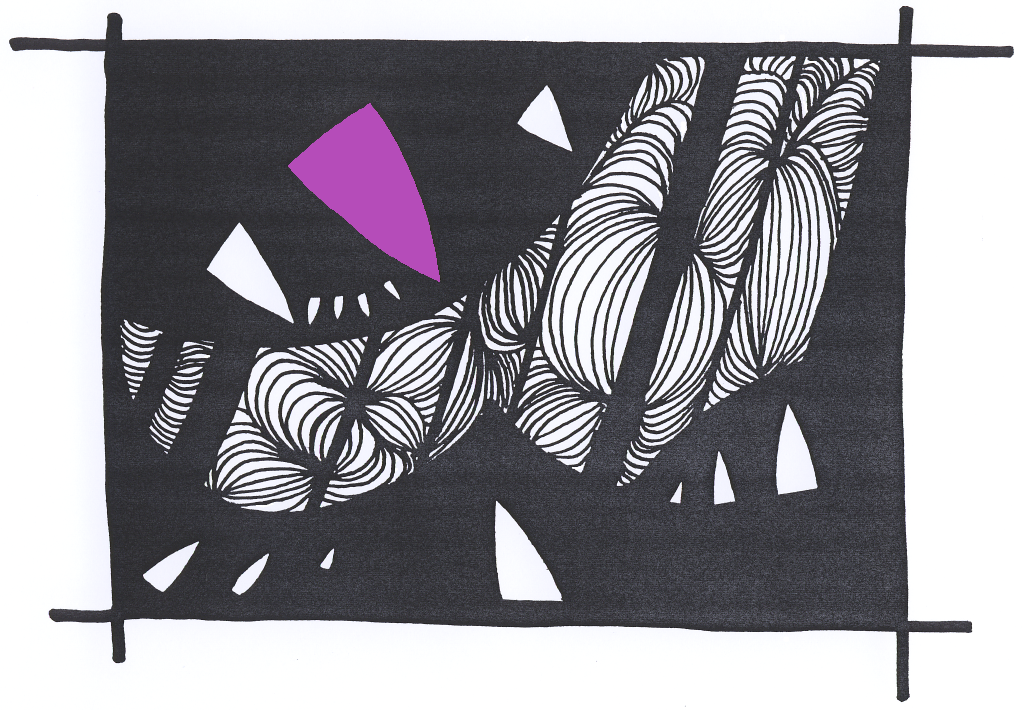
Miraculously, my friend Adam has seen some strange animal behaviour too. Can it be that this sort of thing is actually happening all the time, everywhere around us, but we are just not seeing it because we can't make sense of it?
I wonder where Adam was, to have seen that many unsuited monkeys ... a zoo maybe, a university laboratory, a jungle, a bible transcription warehouse ... and is he obliged to report* this potentially harmful conglomeration of dreamy, yet defiant, primatial nakedness?
One last question: are these monkeys on AWA's? Judging by the tone of their employer, it sounds like if they're not now they will be soon, god save them.
I saw a hundred monkeys on typewriters today
And they weren’t wearing suits
Pointing out their nakedness I insisted
“Find yourselves some uniforms or else find yourselves new work!”
And the monkeys gave no hoots
Dreaming free-spirited hallucinations
Bred from their rebellious act
These nine-to-fivers made art, though their suits had not attended
“Off with you!” I screamed, ‘Before the CEO finds out!”
But the monkeys dreamed on, un-offended
* To Channel 9, say, or Opus Dei.
I wonder where Adam was, to have seen that many unsuited monkeys ... a zoo maybe, a university laboratory, a jungle, a bible transcription warehouse ... and is he obliged to report* this potentially harmful conglomeration of dreamy, yet defiant, primatial nakedness?
One last question: are these monkeys on AWA's? Judging by the tone of their employer, it sounds like if they're not now they will be soon, god save them.
I saw a hundred monkeys on typewriters today
And they weren’t wearing suits
Pointing out their nakedness I insisted
“Find yourselves some uniforms or else find yourselves new work!”
And the monkeys gave no hoots
Dreaming free-spirited hallucinations
Bred from their rebellious act
These nine-to-fivers made art, though their suits had not attended
“Off with you!” I screamed, ‘Before the CEO finds out!”
But the monkeys dreamed on, un-offended
* To Channel 9, say, or Opus Dei.
Tuesday, July 04, 2006
I Saw
I saw a sheep on a bike today
It wasn't wearing a coat
Pointing to its back I said
"you'll get muck on that"
And the sheep began to float
Buoyant, fleecy loftiness
Peddling its bike in the ether
The coat-free sheep ascended
"Come down" I cried "or you'll get a sniffle"
But the sheep's big grin was unbended
I saw a dog on a scooter today
It wasn't wearing a helmet
Pointing to its head I cried
"It'll smash like an egg"
And the dog began to melt
Draining, sticky liquid
Pawing down the roadside
The helmetless dog descended
"Get out" I shouted "or you'll stain people's shoes"
But the dog's tail's wagginess was unended
I saw two fish on a whipper snipper today
Neither was wearing boots
Pointing to their feet I said
"They'll get chopped up like meat"
And the fish began to sniggle
Snickering, snorting aquaticness
Falling all over themselves
The titilated fish somersaulted
"Stop that" I yelled "or you'll spread marine levity"
But the fishs' mirth was unaltered
It wasn't wearing a coat
Pointing to its back I said
"you'll get muck on that"
And the sheep began to float
Buoyant, fleecy loftiness
Peddling its bike in the ether
The coat-free sheep ascended
"Come down" I cried "or you'll get a sniffle"
But the sheep's big grin was unbended
I saw a dog on a scooter today
It wasn't wearing a helmet
Pointing to its head I cried
"It'll smash like an egg"
And the dog began to melt
Draining, sticky liquid
Pawing down the roadside
The helmetless dog descended
"Get out" I shouted "or you'll stain people's shoes"
But the dog's tail's wagginess was unended
I saw two fish on a whipper snipper today
Neither was wearing boots
Pointing to their feet I said
"They'll get chopped up like meat"
And the fish began to sniggle
Snickering, snorting aquaticness
Falling all over themselves
The titilated fish somersaulted
"Stop that" I yelled "or you'll spread marine levity"
But the fishs' mirth was unaltered
Subscribe to:
Posts (Atom)